Bin Picking of Cables
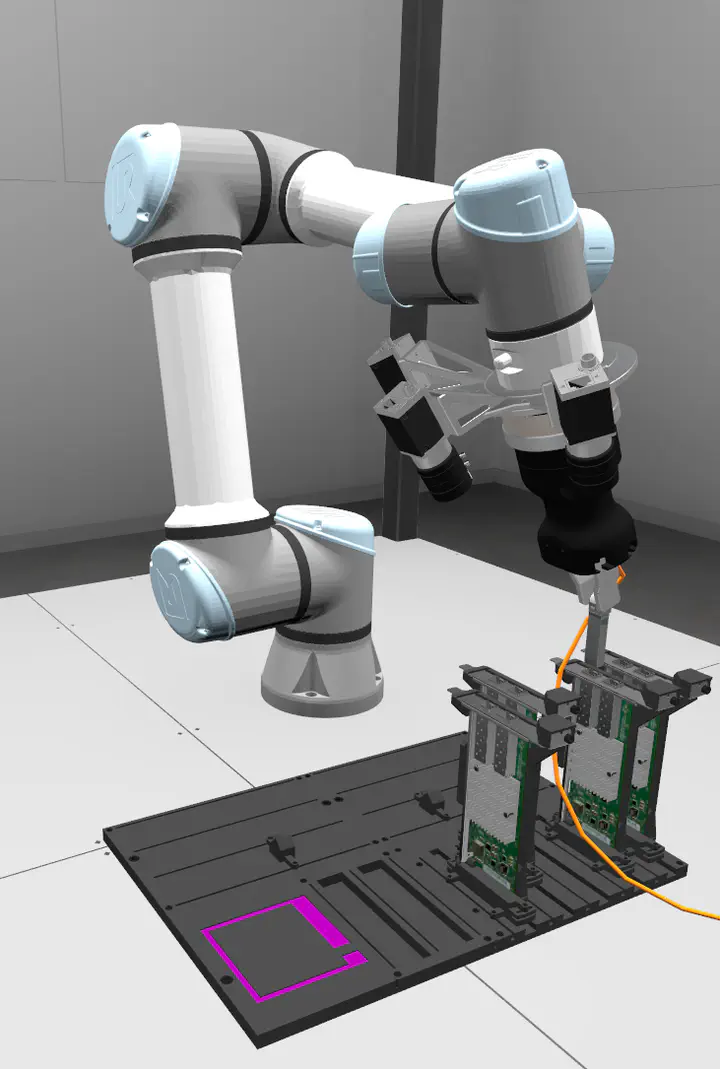 Assembly of an SFP connector in simulation during the “AI for Industry Challenge”
Abstract
Cables are relevant in a large number of electronic products. Handling and assembling cables is therefore an essential task for robots in the automated manufacturing of these products. Due to their limpness, cables pose a challenge for robotics. Because of this property, cables can become knotted, damage to the cable can occur, or difficulties can arise during assembly.
The aim of this thesis is to develop an approach for separating cables and to subsequently compare it with other approaches. The approach should localise connectors and determine grasp poses. A concept for dealing with mutual occlusions of the cables is to be developed.
A further goal is to track the connector pose during the handling operation in order to provide reliable coordinates for the subsequent assembly.
Motivation
Cables are relevant in a large number of electronic products. Handling and assembling cables is therefore an essential task for robots in the automated manufacturing of these products. Due to their limpness, cables pose a challenge for robotics. Because of this property, cables can become knotted, damage to the cable can occur, or difficulties can arise during assembly.
Topic Area
To date, cables are fed individually and in an ordered state into the robotic assembly process. This allows the robot to grasp and localise the connectors easily. Particularly for short cables, this requires pre-sorting. Feeding the cables in a bin involves considerably less effort. In order to separate the cables for assembly, the robot reaches into the bin, a process known as bin picking. However, numerous challenges arise during separation. Cables can become entangled by their connectors while being grasped, cables can become knotted, and connectors may not be identified unambiguously due to overlaps.
Description
The aim of this thesis is to develop an approach for separating cables and to subsequently compare it with other approaches. The approach should localise connectors and determine grasp poses. A concept for dealing with mutual occlusions of the cables is to be developed. A further goal is to track the connector pose during the handling operation in order to provide reliable coordinates for the subsequent assembly.
For practical validation of the developed concepts, collaborative robots from Universal Robots and, in the near future, a dual arm robot are available. The latter is a humanoid robot without legs. The robots are located at the Technology Transfer Centre Nürnberger Land in Lauf.
Requirements
- Programming skills (preferably Python and/or C++)
- Ideally initial experience with ROS
- Interest in bin picking
This topic is suitable for a bachelor’s, project or master’s thesis and can also be combined with further topics for an M-APR.
Supervision
| Role | Name | |
|---|---|---|
| Supervisor | Prof. Dr. Christian Pfitzner | christian.pfitzner@th-nuernberg.de |
| Co-Supervisor | M. Sc. Patrick Fußy | patrick.fussy@th-nuernberg.de |
Location: TTZ Nürnberger Land, Martin-Luther-Straße 18, Lauf an der Pegnitz
Further information: TTZ Nürnberger Land · Mobile Robotics Lab

Prof. Dr. Christian Pfitzner
Professor of Mobile Robotics
Professor of Mobile Robotics at TH Nürnberg Georg Simon Ohm, Faculty efi. Director of the TTZ Nürnberger Land. Research interests in autonomous navigation, drone technology and sensor fusion.